
Something I wrote back in 2008 while taking a class on the New Testament. It breaks down, in very basic form, when why, and by whom the "books" in the New Testament were written.
• Matthew
Written by Jesus’ disciple Matthew (Levi) around A.D. 60-65. There are twenty-eight chapters written primarily to the Jews to tell them that Jesus was the prophesied Messiah.
Matthew introduces Jesus as the Messiah and eternal King of Kings and shows his brief ministry as one that will withstand throughout the ages through love, faith, salvation, and living life as Christ did.
• Mark
Written by Mark, the companion of Paul around A.D. 55 and 65. There are sixteen chapters written primarily to the Christians in Rome to show the person that Jesus was, his teachings, and his works.
Mark shows that Christ is the son of God and profiles Jesus’ miraculous “powers” through miracles and defeating death in his resurrection.
• Luke
Written by Luke, a doctor (and only known Gentile author of the New Testament) who was a close personal friend and companion of Paul’s around A.D. 60. There are twenty-four chapters written primarily to Theophilus, the Gentiles, and people everywhere to present Christ as the perfect man and Savior.
Luke introduces Jesus as the ultimate perfection and creates an account of God entering man’s world on man’s level with the promise to never leave, illustrated by the appearance of the Holy Spirit following the ascension of Jesus into Heaven.
• John
Written by the apostle John (son of Zebedee and brother of James) around A.D. 85-90. There are twenty-one chapters written primarily to the new Christians and non-Christians who were seeking a new truth to prove that Jesus was truly the son of God and offered eternal life through faith in Him.
John shows Jesus as a human man, full of man’s desires and weaknesses yet fully as God and through faith in Jesus, our place in Heaven is not only guaranteed but welcomed and most wanted.
• Acts
Written by Luke (also the author of the book of Luke) around A.D. 63-70. There are twenty-eight chapters written to Theophilus to give an accurate account of the birth and development of the Christian church.
Luke presents the atrocities and tribulations that early Christians encountered due to their faith in Christ and by their willingness to endure whatever mankind brought about, their faith proved that this new faith was most certainly from God.
• Romans
Written by Paul (formerly Saul the Pharisee and persecutor of Christians and the most prolific author of the New Testament) around A.D. 57. There are sixteen chapters written to Christians in Rome and everywhere mainly to provide an introduction for Paul to the Romans and provide a “sample” of his message before his arrival in Rome.
Paul’s letter emphasizes the grasp of sin on mankind and that through faith, love, and obedience in Christ, one is able to overcome sin and effectively spread the gospel to others in the while God cares about His children, he will not abide unbridled sin and mankind must come to God for forgiveness.
• 1 Corinthians
Written by Paul around A.D. 55. There are sixteen chapters written to the church in Corinth for the purpose of identifying the problems in the church as well as alerting the church about false preachers and how to live in a Christ-less society.
Paul’s letter warns of a church divided due to false teachings and preachers and tells the church to rely on the teachings and examples of Christ alone and in the dogma that he himself had provided as a basis of true Christian worship.
• 2 Corinthians
Written by Paul around A.D. 55-57 from Macedonia. There are thirteen chapters written to the church in Corinth and all Christians to validate his own ministry as an apostle and rebut the false preachers in Corinth.
Paul’s letter speaks of discipline and tells followers not to focus on the opposition to Christianity but rather to remain faithful and diligent in presenting the gospel of Christ in a true and right manner.
• Galatians
Written by Paul around A.D. 49 from Antioch. There are five chapters written to the churches in southern Galatia to refute and challenge the Judaizers (those who taught that the Gentile “Christians” must follow Judaic laws in order to be saved) and challenge the Christians to act upon their faith in Christ.
Paul’s refutes the idea that Gentiles must follow Judaic laws in order to be recognized as Christians in that salvation and faith and love in Christ were more important that rituals and ceremonies.
• Ephesians
Written by Paul around A.D. 60 from Rome during his imprisonment. There are six chapters written to the church of Ephesus and to Christians everywhere to help their foundation of faith and strengthen their belief in Christ by telling them of the purpose of the church and teaching them of the nature of the “body of Christ.”
Paul encourages Christians to remain faithful in their love of Christ in that God’s love and Christ’s sacrifice upholds their salvation.
• Philippians
Written by Paul around A.D. 61 from Rome during his imprisonment. There are four chapters written to the Christians at Philippi and everywhere to thank them for the gift they had sent to him and to strengthen their faith by showing that true happiness comes from Christ and Christ alone.
Paul is encouraging believers to hold fast to their faith and find peace and security in the knowledge that Christ loves them.
• Colossians
Written by Paul around A.D. 60 from Rome during his imprisonment. There are four chapters written to the church at Colosse and to Christians everywhere to refute errors in the church and to show believers everywhere that they lack nothing if their faith is in Christ alone.
Paul reminds Christians that Christ is everything and anything that they need and not to fall prey to false preachers and teaching when they feel the struggle in their faith has become unbearable or unbelievable.
• 1 Thessalonians
Written by Paul around A.D. 51 from Corinth (this was one of Paul’s earliest letters). There are five chapters written to the church at Thessalonica and to Christians everywhere to strengthen their faith and to assure them of Christ’s return.
Paul warns of persecution and even death for their faith in Christ but assures them that Christ loves them and will return for the faithful.
• 2 Thessalonians
Written by Paul around A.D. 51 or 52 from Corinth (it is suggested that Paul wrote this letter a few months after 1 Thessalonians). There are two chapters written to the church at Thessalonica and Christians everywhere to clear up any confusion regarding the second coming of Christ.
Paul encourages Christians to remain faithful and true to the teachings of Christ and berates those who have misconstrued the gospel for their own gain.
• 1 Timothy
Written by Paul around A.D. 64 from Rome, Macedonia, or Philippi probably just prior to his last imprisonment in Rome. There are six chapters written to Paul’s young companion Timothy to encourage him and give him instructions as a leader for Christ.
Paul instructs Timothy to keep the foundation of Christ’s teachings intact and to fight against corruption in the church by remaining true to the gospel and life of Christ.
• 2 Timothy
Written by Paul around A.D. 66 or 67 from Rome during his imprisonment. There are two chapters written to Timothy (a companion and elder at the church of Ephesus) to give him final instructions to follow after Paul’s death and to offer him encouragement to strengthen his faith and help him grow as a leader.
Paul encourages Timothy to remain faithful in the face of adversity as Christ remained faithful to his mission to the point of sacrificing his own life for the eternity of mankind.
• Titus
Written by Paul around A.D. 64 probably from Macedonia and about the same time he wrote 1 Timothy. There are three chapters written to Titus to give him support and instruction regarding his responsibility of leading the churches on the island of Cree.
Paul reminds Titus that good works are nothing without faith and vise versa and one must be a good example as much as a good leader.
• Philemon
Written by Paul around A.D. 60 from Romeduring his imprisonment around the same time he wrote Ephesians and Colossians. There is one chapter written to Philemon telling him to forgive his runaway slave Onesimus and to accept him in faith as a Christian brother.
Paul encourages Philemon to remember that all men are equal in Christ and that slavery is not of God.
• Hebrews
The “true” author is unknown but it has been attributed to Paul, Luke, Barnabas, Apollos, Silas, Philip, Pricilla, and many others. The author’s name is not given in the text itself but whomever he or she is, refers to Timothy as “brother.” Hebrews was penned probably around A.D. 70 which is supported by the naming of ceremonies and sacrifices without mention of the destruction of the Temple’s destruction. There are thirteen chapters and written for the Hebrew Christians who were struggling with their newfound faith and considering returning to the Judaic ways for lack of faith and understanding of this new way of religious life.
Hebrews reminds us all that perseverance an faith in Christ alone, throughout trials and uncertainty in mankind, we are one with Christ and are able to count on our salvation to help us love and assist others whether they believe the same or not.
• James
Assumed to be written by James, brother of Jesus around A.D. 49 before the Jerusalem Council held in A.D. 50. There are five chapters written to the first Jewish Christians in the Gentile communities outside of Palatine and to Christians everywhere to open their eyes to unethical behaviors and to teach them how to be good Christians in their actions and words.
James presents the message of salvation through grace in God’s love and mercy for all mankind and encourages believers to spread the gospel in the same manner of Christ.
• 1 Peter
Written by Peter around A.D. 62-64 from Rome. There are five chapters written to the Jewish Christians who were driven out of Jerusalem, those in Asia Minor, and everywhere to give them encouragement through their suffering for their faith.
Peter comforts believers in that their faith will carry them through the persecution that is sure to follow them and instructs them to maintain a pure relationship with God.
• 2 Peter Written by Peter around A.D. 67 about three years after 1 Peter
probably from Rome. There are three chapters written to the entire church of Christ (Christians everywhere) to warn them of false prophets and preachers and to encourage them to grow in their faith and knowledge of Christ.
Peter tells believers that if their faith is true, it will be evident in their walk and others will see and want to share in the peace and love they see coming from them.
• 1 John
Written by the apostle John around A.D. 85 and 90 from Ephesus. There are five chapters written to no one in particular. This was a pastoral letter and sent to several Gentile congregations but was also for Christians everywhere to help encourage and reassure them in their faith and warn them of false prophets and false teachings.
John instructs believers to remember that no matter what, God is in control and regardless of what they may experience in this life, it is nothing compared to the love they will experience from God in the next life.
• 2 John
Written by the apostle John around A.D. 90 fro Ephesus. There is one chapter written to Cyria and those in her home to instruct and the basic teachings of Christ and to war against the false teachers and teachings.
John warns of false teachers and that following the Word of God with faith is essential in teaching and living the true gospel of Christ.
• 3 John
Written by the apostle John around A.D. 90 from Ephesus. There is one chapter written to a man names Gaius to praise him for his hospitality and to encourage his growth in his Christian life.
John praises Gaius for taking in traveling Christians and encourages believers to do the same in that humbleness and openness to others is an essential part of the Christian life.
• Jude
Written by Jude (half-brother to James and Jesus) around A.D. 65. There is one chapter written to Jewish Christians and Christians everywhere to remind them that there must be a constant mindset to remain in one’s faith in order to remain strong in their walk and protect the message of Christ from those who would distort it.
Jude reminds believers to remain true to the teachings of Christ and warns those who misrepresent it, as well as their followers, that ultimately, they will be punished.
• Revelation
Written by the apostle John around A.D. 95 from the island of Patmos where he had been exiled. There are twenty-two chapters written to the seven churches in Asia and to Christians everywhere to reveal all of who and what Christ was and is, to warn of false prophets and teachings, and to give hope to everyone that ultimately Christ’s love will overcome the works of Satan.
John encourages faith in Christ but also warns of the consequences to those who reject God’s love and salvation and to those that follow anyone who preaches against the gospel of Jesus.
References
1. Life Application Bible. “The Living Bible.” Tyndale House Publishers, Inc. and Youth for Christ/USA. Copyright 1988.
Friday, August 6, 2010


Contributing to the Needs of the Saints (From July 11, 2010)
Ron and I went to church today at my old church in Topeka, First Congregational Church . It's the first time I've set foot inside a church in nearly five years and before anyone gets all excited and starts "welcoming" me back to the "fold," just hold your horses for a minute and calm down.
I began my relationship with the United Church of Christ in 2001. At the time, I attended Seabrook United Church of Christ in Topeka until it joined together with First Congregational Church in 2004, I believe (Tobias can correct me if I'm wrong on this). When I first began attending church there, I met Rev. Tobias Schlingensiepen and immediately enjoyed not only his personality and attitude, but the presentations of his sermons and apparent mentoring and ministering spirit about him.
I left the church sometime in late 2005 because of personal reasons at the time, but reconnected with Tobias shortly after my return to Kansas in mid-2009. When Ron was in ICU in Topeka, my brother JD Nash and Tobias, along with Paul Beck from the church (another good friend of mine), came to visit us. While re-connecting in person was nice, it was obviously a difficult and stressful time for Ron and me, so a more casual meeting would have to wait.
Well, we've had the opportunity to do so, having had brunch with Tobias in Topeka just a few weeks ago after one of Ron's doctor appointments. We discussed the possibility of Ron and I attending a service and last night, we decided that today was the day. My reason for going, was to see old friends again and perhaps make some new ones and as always, to learn from Tobias' sermon as I've always done. Ron's reason for going, well, you'll just have to ask him.
And yes... it rained not long after my presence "darkened" (as one friend of mine so lovingly put it, lol!) the door of the church.
Well, the moment we pulled up to the church, I updated my status here and it read as follows:
Are you talking the talk, or walking the walk? Talking doesn't feed, clothe, shelter, quench thirst, comfort, protect, or love.
It doesn't take a person of any particular "faith," to do these things.
Just someone who cares.
When you see others less fortunate than you, don't be grateful for what you have, be grateful that you can give to those who have less.
Now, the reason I wrote this is, last week a good friend of mine had on her status that she'd seen homeless people and was grateful to God for what she had and shouldn't complain so much about what she didn't have. Another comment a few days later was regarding the "simple" things in life and how wonderful they are. And while this is true, it sparked a little anger in me and caused me to think do a little reflection on my own life.
Well, when the sermon began, I nearly disrupted Tobias laughing when I saw the scripture he was using. It eerily mirrored my status update from less than an hour before.
Now, before I go any further, let me remind you that I am not a Christian, nor do I wish to be one. I am an ordained minister and have been for years, but I subscribe to no particular faith and again, nor do I choose to. I define myself as an Existential Agnostic Deist, and I will go into the definition, MY definition, of that term later on in this note.
The title of the sermon today was Drawing Together, and Tobias used Romans chapter 12 as the scripture. Yes, I said Romans 12, the entire chapter. I however, am going to focus on verse 13, which tells us, "Contribute to the needs of the saints; extend hospitality to strangers."
Note the words in bold... you'll be seeing them again.
I appeal to you therefore, brothers and sisters, by the mercies of God, to present your bodies as a living sacrifice, holy and acceptable to God, which is your spiritual worship. Do not be conformed to this world, but be transformed by the renewing of your minds, so that you may discern what is the will of God—what is good and acceptable and perfect.
For by the grace given to me I say to everyone among you not to think of yourself more highly than you ought to think, but to think with sober judgment, each according to the measure of faith that God has assigned. For as in one body we have many members, and not all the members have the same function, so we, who are many, are one body in Christ, and individually we are members one of another. We have gifts that differ according to the grace given to us: prophecy, in proportion to faith; ministry, in ministering; the teacher, in teaching; the exhorter, in exhortation; the giver, in generosity; the leader, in diligence; the compassionate, in cheerfulness.
Let love be genuine; hate what is evil, hold fast to what is good; love one another with mutual affection; outdo one another in showing honour. Do not lag in zeal, be ardent in spirit, serve the Lord. Rejoice in hope, be patient in suffering, persevere in prayer. Contribute to the needs of the saints; extend hospitality to strangers.
Bless those who persecute you; bless and do not curse them. Rejoice with those who rejoice, weep with those who weep. Live in harmony with one another; do not be haughty, but associate with the lowly; do not claim to be wiser than you are. Do not repay anyone evil for evil, but take thought for what is noble in the sight of all. If it is possible, so far as it depends on you, live peaceably with all. Beloved, never avenge yourselves, but leave room for the wrath of God; for it is written, ‘Vengeance is mine, I will repay, says the Lord.’ No, ‘if your enemies are hungry, feed them; if they are thirsty, give them something to drink; for by doing this you will heap burning coals on their heads.’ Do not be overcome by evil, but overcome evil with good.
Let's get this straight right off, I am NOT a fan of Paul; never have been, never will be. But let's look at what he's really saying in his epistle to the Romans. I'm going to borrow some definitions from Tobias (one of the many reasons I've enjoyed talking with him, he's a wonderful and patient teacher and always leaves me wanting to know more).
Paul wrote in Greek, not Hebrew, although he was a Jew. Most of the Biblical texts we English readers have today have been translated into Latin, German, and then English, if my memory serves.
So, back to verse 13.
Let's look at the word "contribute." Tobias pointed this out today and it's stuck with me. First of all, what do you think of when you hear the word "contribute?" Easy, you give, right? But what do you give? Money? Food? Clothing? Well, certainly but...
What about yourself? The word "contribute" in Greek, is "koinónos," which means to "share" or "have a share of." So, if you are contributing to the needs of the saints, what exactly are you doing? You are sharing, taking an active part in not "donating" to what they need, but to all their needs. Whether it be physical, mental, emotional, spiritual, financial, etc., you take an active part in their lives, sharing in their need, and helping wherever you can. Prayer's great folks, but it doesn't fix a leaky faucet or comfort the spirit of someone who is hurting.
Tobias spoke of twenty people in the congregation who came together last week (or perhaps I should say "gathered," considering the title of today's sermon) and went to someone's home and helped them paint. Good food, helping hands, joined spirits, and a job well done for someone who needed action, not words.
Now let's look at the word, "saint." Just who should be considered a saint? The Greek transliteration of the word, is "agiōn," which means "sacred," or "holy." Okay, and who is considered sacred or holy? Well, are we all not one in Christ, irregardless of our background?
In Paul's epistle to the Galatians, chapter 3 verse 28 it tells us, "There is neither Jew nor Greek, slave nor free, male nor female, for you are all one in Christ Jesus." So, does this apply to non-Christians? Are they not God's creation as well? Does a father not love his children, regardless of whether or not they follow the path he has chosen for them? Even if they are strangers to us, are they not still family, under the provisions that we are all children of God?
Hang on a minute... strangers. Paul mentioned strangers too. Feeling a little uncomfortable now? He said to extend hospitality to strangers. Bet you're REALLY feeling uncomfortable now. Are you squirming? Not yet? Give it time... Hospitality... what did he mean by that?
"Hospitality" comes from the Greek word, "philoxenos," meaning "love of," and what better way to "love" a stranger, than with the all-encompassing love and provisions of God, that God has blessed you with?
If a stranger came to your door in need of food, clothing, or water? Would you give it to him? More than likely, yes. If a stranger came to your door in need of shelter, would you offer it? More than likely... not. And yet you call them brothers and sisters?
I'm going to go a little off here and refer to the word "genuine," and what it means. Yep, Greek again. "Anupokritos," is the transliteration for " without hypocrisy." Let's look at that instruction again... "Let love be genuine..." Let love be without hypocrisy.
Tell me then, if you close your door to a stranger, how can your love be genuine?
Matthew 25:44-45 describes Jesus explaining a hypocritical love. "They also will answer, 'Lord, when did we see you hungry or thirsty or a stranger or needing clothes or sick or in prison, and did not help you?' "He will reply, 'I tell you the truth, whatever you did not do for one of the least of these, you did not do for me.' "
The least of these. Is not the persona of Christ himself to be assumed in whomever we meet? Do you give a homeless man a cup of coffee or do you offer him a meal, a shoulder, an ear, and a ride to the shelter? Do you see a woman crying on a bench and offer to pray for her, or do you ask her what's wrong and take action to correct her situation.
While in this day and age it may not be safe to offer shelter in one's home to a stranger, there are alternatives to assuring no one goes hungry, thirsty, cold, or without shelter. But do we bother? Or do we sadly shake our heads, peeking from behind our comfort zone and say, "I'm sorry, but I can't help you, maybe the church down the road can give you what you need."
Well my friends, WE are the church down the road. No buildings, no hymnals, no stained glass windows, no coffee and cookies after the sermon, and not even a Bible can "contribute to the needs of the saints," simply because we are the church. The congregation. The community. The very embodiment of Christ himself, sanctioned with the responsibility to carry on his ministry, which was not one of liturgy, baptism, confirmation, communion or gathering of "like minds," or religious beliefs, but rather one of love, compassion, healing, and helping for all mankind.
And as I end, what was that scripture about angels unaware... oh yes, Hebrews 13:2. "Do not forget to entertain strangers, for by so doing some people have entertained angels without knowing it."
Here we go with the Greek again... the word "entertain," transliterates to "xenisantes," meaning "to receive as a guest or to surprise," and the word "angels," transliterates to "angelous," meaning "a messenger or angel."
Kind of goes along with that whole "hospitality," "genuine," and "saints" thing doesn't it? And was not Christ the Messiah? Messiah... comes from the Greek, "ma·shi·ach," meaning "anointed," was he not a messenger of God, the anointed one? And aren't we, as children of God and followers of Christ, not messengers of that very ministry of Christ and messengers of God?
James 2:20 tells us "You foolish man, do you want evidence that faith without deeds is useless?" (in older translations, "dead"). Foolish... Greek transliteration is "kene," meaning "empty." Useless... Greek transliteration is "argē," meaning "inactive, or idle..."
So, an empty man has no faith, for without works, it is idle. Kind of harsh, isn't it?
Not really... just another way of asking... Are you talking the talk, or walking the walk?"
Oh and about that definition of the Existential Agnostic Deist bit? It just means I'm someone who takes responsibility for what I do, say, and think, I do not have all the knowledge, and I believe in a Deity based on science and nature.
Now, I'll just let you decide, just how much of a heathen I am... ;-)
Monday, March 29, 2010
BREAKING THE CYCLE: Alcoholism and Fetal Alcohol Syndrome In Native American Indians
BREAKING THE CYCLE: Alcoholism and Fetal Alcohol Syndrome In Native American Indians
N.R. Fox © 2004
(This report was originally written in 2004 as a research paper. Although several years have passed, the incidence of alcoholism in Native America continues to rise and with it, crime, rape, and poverty are also on the rise. It is the author's belief that the information within this report remains just as important and valid as when it was written.)
When one contemplates the concept of Fetal Alcohol Syndrome (FAS) based on current and cultural data, the facts have not always been available to the general public. Unfortunately stereotyping and myths tend to make up the mass of what many believe to be factual details of this debilitating and preventable disease. Fetal Alcohol Effects (FAE) is a similar but less profound condition which has fewer symptoms than FAS and will not be discussed in this report.
Before alcoholism can be understood, it must first be defined. Dr. David Ohlm defines alcoholism as a "chronic, progressive, incurable disease, characterized by loss of control over alcohol and other sedative drugs."
“In an alcoholic, when the body is digesting the alcohol, it produces an excess of the neurotransmitters tetrahydroisoquinolines, or TIQs. These TIQs are addictive, and create opiate substances, or an endorphins, which is a stimulant. These TIQs behave similar to cocaine, in their addictiveness, and affects on the brain (Ohlm). In social drinkers, the reaction does not take place and do not create these TIQs, but depress the production of endorphins, therefore feeling bad, having the alcohol act as a depressant. Some people do create these TIQs, and feel good, causing the alcohol to act as a stimulant, which can be addictive and cause alcoholism. To demonstrate the effects of TIQs, rats have been used. There is a strain of genetically engineered rats which detest any alcohol. They would die of thirst before even drinking 3% alcohol. But, when injected with TIQs, the rats prefer drinking 100 proof alcohol over water. This demonstrates the addictiveness, and how the TIQs override other inhibitions. All of these physiological differences provide for increased chances for the occurrence of alcoholism, and all of them could very likely be passed through genetics” (Esser).
In 1987 most reported cases of FAS in the United States came from study sites where the mothers were black or Native American and of low socioeconomic status. According to the CDC catchment study in 1989, incidences of FAS per 10,000 births were Asians 0.3, Hispanics 0.8, Whites 0.9, Blacks 6.0, and Native Americans 29.9 (Narconon). Other studies have shown that Native Americans are 33% more likely to have a child with FAS than those of other races (Stump), while the US Department of Health and Human services report that FAS among Native Americans children can be as high as 103 in every 10,000 births (Kellerman).
So the question arises, why is there such a high incidence ratio for Native Americans? There is, at present, much controversy in the medical community regarding the possible underlying cause(s) for FAS in any culture. However, Native Americans also have a higher ratio per capita for both those raised within the culture, as well as those not raised within the culture (Streissguth, et al). Studies are showing that the age-old debate between nature vs. nurture,bears further research into this medical and ethnic phenomenon (Prescott).
While there is no intent to discredit or exclude the rising number of FAS births in other races and cultures, historically FAS has been predominantly unrecognized in Native American families. But to establish a historical precedent there must be an understanding of the diagnostic tests that are used to determine FAS and the realization that until recently, Native children were less likely to be tested or treated unless raised within a non-native family. Due to the physical features of Native infants, facial recognition is the least accurate measure of diagnosis; thus the expensive and time-consuming procedures that follow were not utilized for a people whom the government coerced into sterilization procedures in the early 1970’s. From the government’s prospective, it was easier to intentionally abort hundreds of pregnancies or sterilize over 12,000 Native women, most without their consent or full knowledge of the procedure, than educate them on the dangers of drinking while pregnant (England).
As is obvious in the following diagram, the physical characteristics of FAS closely resemble those of a normally developed Native American child. The squat nose, epicanthal eye folds, thin upper lip, and flat midface make it increasingly difficult to diagnose a Native child with FAS unless the maternal drinking habits of the mother are known in advance. Many of these features become less pronounced at the children grow older. Children with FAS are more likely to have congenital heart disease, poor coordination, abnormally formed organs and mental retardation (Leung).

A diagram of the different facial dysmorphologies a child with FAS may display
In infants FAS is much easier to diagnose than it is in adolescents and adults. FAS can be diagnosed when patients have a positive history of maternal alcohol abuse during pregnancy and growth deficiency of prenatal origin (height and/or weight); a pattern of specific minor anomalies that include characteristics generally defined by a small head, lack of vertical ridges between the nose and lip, thin upper lip, narrow eye slits, delayed adjustment, attention deficits, learning disabilities, low IQ, and seizures. While mental retardation does not always accompany FAS, most patients have major psychosocial problems and adult victims may have difficulty maintaining successful independence. Other patients, however, may show no physical signs of FAS and diagnosis is not made until much later in life, thus leaving the patient feeling as if he or she were simply a “bad seed.”
Steph Braddock, director of the Missouri Fetal Alcohol Syndrome Center in Columbia, says the ideal time to diagnose FAS is between the ages of eight months and eight years. “Diagnosis will entail proper screenings and testings to pinpoint the patient’s strengths and weaknesses and ensure the child has a proper intervention plan. We also want to make sure the mothers are in treatment. We can’t undo what has happened, but with appropriate intervention, we can provide treatment and, we hope, prevent it from happening again in the future.” Braddock also says that health care providers may not initially diagnose children with FAS, although many of the neurobehavioral problems exhibited, such as poor communication or memory, may lead to secondary disabilities and behavior problems. Although the ideal age is commonly overlooked in these diagnostic procedures, Braddock says that children will benefit from screening even if they are older than eight years old (Ghan).
The difficulty with diagnosing adolescents and adults arises as the abnormal physical characteristics eventually give way to normal physiological growth. The physical and mental manifestations of the syndrome in adolescents and adults have remained an important unsolved area of investigation (Steissguth, et al).

(Photo Courtesy of Teresa Kellerman)
How, then, do genetics come into play regarding the higher rate of Native Americans with FAS? Scientists have known for some time the rate of alcohol metabolism can vary as much as threefold among people with similar drinking habits and recent studies indicate that the development of alcoholism is influenced by both genetic and environmental factors. "It appears that the development of alcoholism is not a case of genetics versus the environment; it is one of genetics and the environment," says Dr. Ting-Kai Li, distinguished professor of medicine and biochemistry at the Indiana University School of Medicine in Indianapolis. Dr. Li’s research has identified two specific genes that protect against heavy drinking. These genes are particularly prevalent among Asians. This research has also shown that Native Americans do not have these protective genes. The transformation that is particularly effective is a mutation of the gene for the enzyme aldehyde dehydrogenase (ALDH), which plays a major role in metabolizing alcohol. Medical research has shown that alcohol is metabolized principally in the liver, where it is converted first to acetaldehyde by the enzyme alcohol dehydrogenase (ADH). Alcetaldehyde is then converted to acetate by the enzyme aldehyde dehydrogenase (Kibbey).
A genetic study by Denis Lowe Viljoen, head of the department of human genetics at the South African National Health Laboratory Science and University of the Witwatersrand faculty of Health Sciences, has shown the incidence of FAS cases in Native American children to be eight per one thousand, while the rate for the White population was 0.33-2.2 and 2.29 for inner city African Americans. Amanda Krause, a researcher and associate professor with Mr. Viljoen, states, “There is good scientific evidence that FAS, like virtually all diseases, has some genetic and some environmental influences.” She points out that ADH is one of two enzymes that act sequentially to metabolize alcohol in the liver and it is ADH that converts alcohol to acetaldehyde (Kibbey).
What these studies have shown is that acetaldehyde produces unpleasant physiological reactions even at low concentration, so the presence or absence of the gene mutation affecting aldehyde dehydrogenase in turn affects drinking behaviors. When acetaldehyde is not rapidly converted to acetate, the results are dramatic: a rapid increase in blood flow to the skin of the face, neck, and chest, rapid heartbeat, headache, nausea, and extreme drowsiness occur. As would be expected, this aversive reaction affects drinking behavior (Streissguth, et al).
A number of researchers have demonstrated that EEG patterns are different in alcoholics and non-alcoholics. It has been determined that the differences are not that of alcohol use, but that these differences are present at birth in identical twins. Individuals at risk for alcoholism can be differentiated on the basis of their EEG alpha activity. Alcoholics have greater increases in slow alpha activity and greater decreases of fast alpha activity after use of alcohol; thus a reduced P300 wave is a good predictor of alcoholism.
The following graphic shows the biological deviations that can occur in the brain due to alcohol consumption during pregnancy. As noted, the corpus callosum in the brain of a normal child shows normal regular growth; while the brain of the child suffering from FAS shows a complete absence of the corpus callosum. Responsible for maintaining much of the communication between regions in different hemispheres of the brain, the absence of the corpus callosum, known as agenesis of the corpus callosum (ACC) can result in mental retardation, cerebral anomalies, eye anomalies, and epilepsy. Autopsies of infants diagnosed with FAS have shown evidence that maternal consumption of alcohol during pregnancy directly affects the development of embryonic brain tissue and can easily result in ACC (Indiana University).
Consider the child who portrays no outward physical symptoms of FAS yet shows a substantial retardation in intellectual, social, emotional, and spiritual growth. Typically, the child would be diagnosed with one of many behavioral disorders (most commonly Attention Deficit Hyperactivity Disorder) and medicated while the underlying effects of FAS remain unrecognized, undiagnosed, and summarily untreated.

(Photo courtesy of Christensen)
Recent studies have shown that alcoholism relapse can be predicted by brain waves. Alcoholics are said to use alcohol, sugar, nicotine, and caffeine in vain attempts to quiet their irritable brain waves (Dapice, et al). It is easy to attribute the issue of genetics coupled with environment and the growing number of Native American children with FAS. With the number of alcoholic persons of European ancestry rising, it is not difficult to perceive the number of culturally separated or mixed blood Native American children stricken with FAS rising as well.
Statistical data confirms an alarming increase in Native American alcohol addicts. Mail and Johnson concluded in a 1993 study that "alcohol is the drug of choice among American Indian people," however, the tragic trend over the years shows recent signs of improvement that bear closer scrutiny.
For those over the age of 12 in 2000, the percentage of "current drinkers" (those who drank in the past month) among the 4 million American Indians and Alaska Natives (35 percent) is much lower than both Whites (51 percent) and Hispanics (40 percent), and only slightly higher than Blacks (34 percent). However, 19 percent of American Indian youth 12 to 17 are past month drinkers—the highest of the major ethnic groups (though the White figure is close—18 percent). For persons over 26, the Native American past month rate is actually the lowest of all. The alcohol abuse problem among American Indians/Alaska Natives appears to be concentrated in the young and the so-called “heavy drinkers” over 26. Binge drinking rates (drinking five or more drinks on one occasion at least once a month) for youth 12 to 17 are highest for Native Americans (12.8 percent do it, versus 11.9 percent for Whites and 11 percent for Blacks). For Native youth who practice "heavy alcohol use" (defined as binge drinking five times a month or more), the rate 1999 to 2000 has declined significantly, from 4.6 percent to 2.9 percent (rates were at least twice as high a decade ago). But after 26, the 7.4 percent rate of heavy alcohol users is highest among Native Americans, and is increasing, while most other groups’ severe use rates are stable or declining (SAMHSA).
And what of nature vs. nurture? A study involving a 37-year-old mixed blood Native American female shows that nurture can play the same role in the development of alcohol abuse as nature.
Born addicted to alcohol and other drugs, the subject was given up for adoption at birth and placed within a non-native home with no history of alcohol or drug use. By the age of five, she had taken her first drink of alcohol, stating it was a “familiar and welcomed experience.” Although she had not been subjected to alcohol in the home, she now believes that she was an alcoholic at birth, but a willing alcoholic by the age of sixteen (Fox). Abuse was also an issue in the home and research has shown that abusive situations can contribute to the desire for alcohol and other drugs (Dapice, et al). Subsequently, the subject has a biological family history of substance abuse for at least 13 generations.
Medical tests as an adult for unexplained pain and muscle tremors revealed encephalic characteristics for FAS and childhood photographs portrayed the noted physical characteristics. Developmental delays, seizures, and a diagnosis of Attention Deficit Hyperactivity Disorder as well as other psychosocial and mental diagnoses were concurrent with the systemic disorders associated with FAS (Streissguth, et al) (Dapice, et al).
Typical psychological symptoms of FAS can include immature social development, being overly friendly to strangers, lack of sexual boundaries, emotional liability, poorly developed conscience, lack of consistent impulse control, good expressive language skills, talented in art, music, or mechanics, attention deficit; not always hyperactive, but easily distracted by external stimuli, short-term memory deficits, inappropriate social interactions, difficulty managing money, a poor concept of time, grandiose ideas and unrealistic life goals, distorted perceptions, poor judgment, vulnerability and naiveté (Kellerman).
Children afflicted with FAS are unfortunately at risk for even further psychological and/or psychosocial difficulties as they mature. Learning processes are interrupted or distorted, making the typical educational system inadequate to successfully instruct and prepare the child for independent adulthood. In areas such as reservations or inner cities where the majority of Native American children afflicted with FAS are raised, it becomes painfully obvious that limited opportunities, coupled with distinct learning disabilities sentence the child to a life of poverty and an exceedingly high risk of further substance use/abuse as an adult.
The level of distractibility experienced increases with the difficulty of the task at hand. A link has also been established between FAS and Attention Deficit Disorder (ADD). 85% of children with FAS also have ADD. In these particular children, the onset is usually earlier, and encompasses more severe developmental, psychiatric, and medical aspects.
Impulsive behavior is another commonly noted characteristic of children with FAS. These symptoms can manifest by having the children place themselves in dangerous situations where they can find themselves retaliating in anger by verbally or physically means to difficult situations. This aspect of behavior often diminishes during adolescence.
Memory skills in children with FAS may be affected at three different stages (depending on the length of time the fetus was exposed to alcohol, the degree, and during which trimester(s). If the sensory abilities were compromised in development, it would affect the children’ ability to take in’” memories. If the storage abilities were compromised during development, than memories will not be sorted as effectively. If the retrieval systems were compromised during development; than the child will not always be able to retrieve memories that they have retained.
Finally, FAS children have a particularly hard time remembering sequences of information (Leung).
On a social level, children with FAS are at a distinct disadvantage and often find themselves ostracized by their peers. FAS children have fewer inner resources for coping with normal stresses and pressures of everyday living. FAS children also experience more problems in adapting to change and making choices.
Some children with FAS excel in the area of motor skills; these are good activities to build self-esteem and lifelong leisure pursuits for children suffering from FAS. Others children that suffer from the disorder have significant problems with gross & fine motor skills. Learning coordinated movements (such as writing) may be more delayed in FAS children.
FAS children experience significant problems in communicating due to the face that they develop their language skills at a slower rate. Often FAS children are observed to use “cocktail party conversation,” fluent words which are void of content.
Ironically, children with FAS are often eager to learn. This is a resource that must be encouraged and refined from the beginning in order to be maintained.
Amazingly enough, children who suffer from FAS are often creative, musical, and artistically gifted. Furthermore, artistic activities can greatly expand the range of thoughts, images, and feelings in all children but it is especially helpful for children with FAS. For instance, music can help the child to perceive, explore, communicate, and reflect upon these things without have to use written form. These subject areas provide FAS children with other “languages of communication” which they often find easier to use.
Many FAS children have trouble learning science skills and processes. This stems from problem solving deficiencies (deduction and inference). Also, they may lack the development of fine motor skills that are necessary to manipulate microscopes. Another common issue with children suffering fro FAS is the inability to understand instructions, or describe observations.
Sequential computation and problem solving also seem to be more difficult for FAS children. Problems with abstract and complex ideas also make math particularly hard for these children.
Underlying language disabilities can also cause difficulties in this area for children with FAS. Sound-symbol associations do not come as easily as to their peers. By intermediate grades, a plateau in reading and writing progression is often reached. This could include the inability to progress in reading and writing skills causes the expectations of teachers unattainable for these children. A slowness to develop abstract thinking is another factor that can make reading comprehension hard for these children. Organizing thoughts in a sequential manner is necessary in writing - another difficult area (Leunng).
Stages of the Developing Fetus
Guidelines of Care for children with Special Health Care Needs
Fetal Alcohol Syndrome and Fetal Alcohol Effects
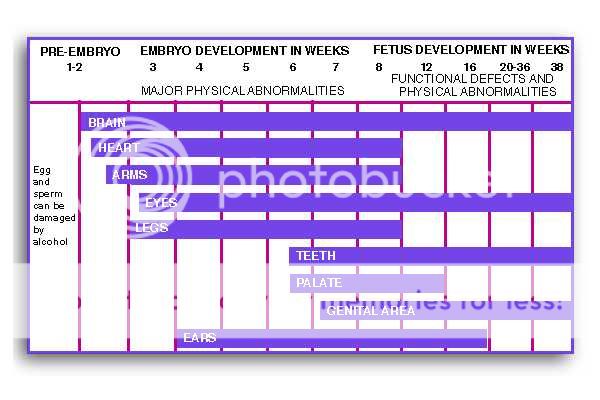 (Minnesota Department of Health 1999)
The graphs below show the progression of disabilities and life-long complications faced by victims of FAS. Note the greatest factor of challenge is that of mental health (first graph) combined with a low level of emotional maturity (second graph) which creates the issues lack of boundaries and consequential thinking.

(Adapted from Streissguth, p.108, 1997)
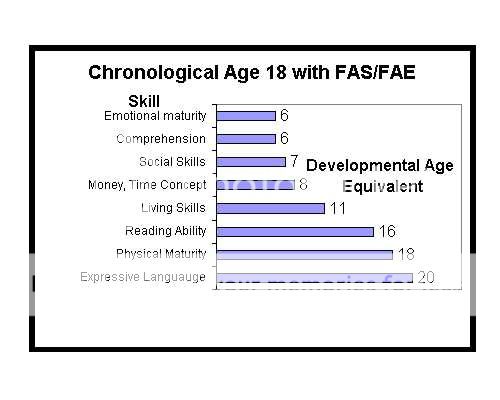
(Adapted from AFM, Undated)
Fetal alcohol syndrome occurs among Alaska Native newborns at twice the national average, and 73 percent of the women who give birth to these FAS children report being sexually abused as a child. Still, Native American resilience has been as legendary as it’s near genocidal history. With a heightened awareness of cultural traditions, prevention specialists have learned some lessons: use American Indians as staff in mental health/substance abuse clinics whenever possible; incorporate cultural concepts and bi-cultural realities within programs; target prevention at early ages (SAMHSA).
While the only prevention for FAS is to abstain from alcohol, it has become apparent that the application of the prevention is not so simple. There is no borderline too much or too little; one drink is too much during pregnancy and the repercussions are immeasurable and undeniably avoidable.
Addiction is not a cultural pastime for Native Americans, but rather an ignored continuing means of attempted genocide (Dapice, et al). Lack of education, treatment options, and appropriate counseling for the Native Americans in understanding the cause and consequences of FAS has been the major contributing factor to the ongoing challenge of eradicating this destructive and needless disease that should have never been introduced.
Works Cited
Christensen, Damaris. Article: Science News. Washington: Jul 8, 2000. Vol. 158, Iss. 2; p. 28 (2 pages) “Sobering work: Unraveling Alcohol's Effects on the Developing Brain” Online. Proquest. Accessed February 28, 2005.
Dapice, Ann N., PhD; Inkanish, Clark, ICADC; Martin, Barbara, B.S.; Brauchi, Pam, MHR, LPC. Article: Native American Times. From The Oklahoma Indian Times, Inc. “Killing Us Slowly: When We Can’t Fight, and We Can’t Run.” Online.
England, Charles R. “A Look at the Indian Health Service Policy of Sterilization.” Online. < http://www.dickshovel.com/IHSSterPol.html >. Accessed March 02, 2005.
Esser, James. “Genetic Influences on Alcholism.” 15 May 1997. Available online at < http://www.brainerd.net/~esserste/essays/alcohol.htm >. Accessed17 March 2005.
Fox, I.G. “Because I Can.” Autobiography. Unpublished. Excerpt. Chapter 6. 2003.
Ghan, Cheri Article: @mizzou. News From Missouri’s Great State University. “MU Houses First Fetal Alcohol Clinic.” Online. < atmizzou.missouri.edu/ jun04/FetalAlcohol.htm >. Accessed February 28, 2005.
Indiana University. “Agenesis of the Corpus Callosum, The Literature 01.” Online. No author cited.
Kellerman, Teresa. Photo Credit. “FAS and the Brain.” Online. < http://www.come-over.to/FAS/FASbrain.htm >, < http://www.come-over.to/FAS/NAFAS.htm >, and < www.come-over.to/ FAS/brochures/ >. Accessed Febrauary 28, 2005.
Kibbey, Hal. University of Indiana. “Genetic Influences on Alcohol Drinking and Alcoholism.” Online.
Leung, Grace. “Research Project: Fetal Alcohol Syndrome & Fetal Alcohol Effects.” Online.
Narconon. “Fetal Alcohol Syndrome.” Narconon of Oklahoma. Article. Online. < http://www.stopaddiction.com/narconon_alcohol_fetal.html>. Accessed February 28, 2005.
Prescott, Carol A. Virginia Institute for Psychiatric and Behavioral Genetics. “Nature vs. Nurture in Progression to Alcoholism.” The Brown University Digest of Addiction Theory and Application. October 1999 v18 i10 p5. Article. Online. Infotrac: Health Reference Center – Academic. Accessed February 28, 2005.
Streissguth, Ann Pytkowicz; Aase, Jon M.; Clarren, Sterling K.; Randels, Sandra P.; LaDue, Robin A.; and Smith, David L. “Fetal Alcohol Syndrome in Adolescents and Adults.” The Journal of American Medical Association, April 17, 1991 v265 n15 p1961. Article. Online. Infotrac: Health Reference Center – Academic. Article A10666511. Accessed February 28, 2005.
Stump, Dan. “Fetal Alcohol Syndrome and Other Drug-Related Birth Defects.” Online. < http://www.msu.edu/~stumpdan/hs/fas.htm >. Accessed Febrauary 28, 2005.
U.S. DEPARTMENT OF HEALTH AND HUMAN SERVICES Substance Abuse and Mental Health Services Administration Center for Substance Abuse Prevention (SAMHSA). Prevention Alert. “American Indians/Alaska Natives and Substance Abuse.” Volume 5, Number 16 November 22, 2002. Accessed 17 March 2005. < http://ncadi.samhsa.gov/govpubs/prevalert/v5/10.aspx >.
Sunday, March 14, 2010
Too Little, Too Late? President Obama Approves Disaster Declaration For Storm Ravaged South Dakota

CRST Tribal Chairman Joseph Brings Plenty presenting Senator Obama with the tribal resolution. The CRST was the first American Indian tribe to endorse Obama for the office of United States President.
March 10th, 2010, seventy-five days after being struck by the first of two major storms that crippled the Cheyenne River Sioux Tribe (CRST) reservation, President Barack Obama issued a disaster declaration for the state of South Dakota.
Although tribal chairman Joseph Brings Plenty issued a state of emergency for the tribe on January 27th, it would take Obama nearly two months to hear the desperate pleas of the Native nation that first endorsed him for President of the United States. While millions of American dollars poured into Haiti and Chile', America's first peoples struggled to survive amidst sub-freezing temperatures and the deaf ears of it's own country.
From the White House website, the following declaration was listed:
"The President today declared a major disaster exists in the State of South Dakota and ordered Federal aid to supplement State and local recovery efforts in the area struck by a severe winter storm during the period of January 20-26, 2010.
Federal funding is available to State and eligible local governments and certain private nonprofit organizations on a cost-sharing basis for emergency work and the repair or replacement of facilities damaged by the severe winter storm in Aurora, Brule, Buffalo, Campbell, Corson, Day, Deuel, Dewey, Douglas, Edmunds, Faulk, Grant, Gregory, Hand, Harding, Hughes, Hutchinson, Hyde, Jerauld, McCook, McPherson, Meade, Perkins, Potter, Roberts, Sully, Turner, Walworth, and Ziebach Counties, as well as those portions of the Cheyenne River Indian Reservation, Sisseton-Wahpeton Indian Reservation, and Standing Rock Indian Reservation that lie within these counties."
In his October 22, 2008 campaign video message entitled, "Barack's Message for First Americans," Obama states the following:
"For twenty months now I've traveled this country often talking about the needs of the American people are going unmet by Washington. And the truth is, few have been ignored by Washington for as long as American Indians. Too often, Washington pays lip service to working with tribes while taking a one-size-fits-all approach with tribal communities across the nation. That will change when I'm president of the United States."
My American Indian policy begins with creating a bond between an Obama administration and the nations all across this country. We need more than just a government-to-government relationship, we need a nation-to-nation relationship; and I will make sure that tribal nations have a voice in the White House.
While tribal nations may have been promised a voice in the White House, it would seem that sadly, those voices have been silenced.
December 24, 2009 brought a crushing winter storm that left the CRST reservation with drifts of ice and snow towering 30 feet and more into the air. Many still remain as a staunch reminder that the crises which blanketed tribal lands with deadly snow and ice, continue to be ignored just as the many promises made, lying in state beneath a blanket of flowery words and smooth assurances that the "change we can believe in" would be a positive change for Native peoples.
January 21st brought new storms that left thousands without power, water, heat, food, medical supplies, and transportation, some for weeks. Nearly ten thousand electrical poles lay scattered across the 2.8 million acres that make up the CRST reservation, the price of which the tribe will be required to absorb as the poles are repaired and replaced.
It has been reported that the state estimates damages from the storm in December will be in excess of $1 million; however no estimates have been provided for the January storms nor have estimates been given regarding the long-term damage to homes, roads, schools, or the health care of tribal members.
From an earlier interview with CRST chairman Joseph Brings Plenty, estimates for repairs to the reservation could be in excess of $100 million. The water infrastructure was put into place some sixty years ago after the Missouri River, the tribe's only natural source of water, was diverted away from the tribe's land. With a "shelf life" of only 25 years, the tribe was assured in 1976 that should the system fail or need repaired, it would be completed without fail. That promise, just as every promise made to the Lakota, has gone unfulfilled and today the tribe continues the already daunting battle to provide clean healthy drinking water to it's members.
It would seem, the "lip service" that President Obama spoke so harshly of in his video message, remains in full effect.
Treaties between the American government and Native nations have gone unfulfilled and as a result, many tribes remain in poverty with crime rates, rape and crimes against women, drug and alcohol addiction, and teen suicide continue to rise. Crises such as these recent storms, only add to the current state of urgency that each tribe faces on a daily basis.
Barbara Low, Mi'kmaq activist," Lakota Helper," (a title of honor) and good friend of Autumn TwoBulls (Lakota youth activist from Pine Ridge) relates the following in regards to the rising incidents of alcoholism and the number of teen suicide on the reservations, "We [share] a history of Genocide, and with that in mind, I would just make one suggestion: Not only is it important to highlight the positive with the negative, [it] is just as important to highlight the fact that the 'negative' is the RESULT of Colonialism induced genocide. Too often, articles are written that miss the step between conditions and solutions. We are not suicidal, impoverished peoples, because we are Indigenous. We are suicidal, impoverished peoples, because of the inter-generational effects of genocide. Over 500 years of colonialism will drive anyone to drink."
In his video message, President Obama one again makes promises that seem to lie further under the snow and ice than many of the reservation roads.
"Here's what else we're going to do. We're going to end nearly a century of mismanagement of Indian Trusts. We're going to work together to settle unresolved cases; figure out how the trusts ought to operate, and make sure they're being managed responsibly. Today, tomorrow, and always. Now I understand the tragic history between the United States and tribal nations. And we've got to acknowledge that truth if we're going to move forward in a fair and honest way. Indian nations have never asked much of the United States. Only for what was promised by treaty obligations made to their fore-bearers. So let me be absolutely clear. I believe treaty commitments are paramount law. And I will fulfill those commitments as President of United States."
Nancy LeBeau, a CRST tribal member and school teacher who lives on the reservation, explained that many roads are still impassible and due to the nature of damages from the storms, many schools are unfit to house the children for lessons. As a result, children are being bused during the early morning hours to rented buildings more than an hour away in order to remain consistent with their schooling. Many families have no means of transportation and should a child miss the bus, there is no way for that child to get to school. She recalls the frustration not only as a teacher, but from the children and their families as they live day to day in poverty and now literally with their community in ruins.
President Obama also guaranteed "...a world class education for all our children. I'll work with tribal nations to reform 'No Child Left Behind,' and create opportunities for tribal citizens to become teachers, so you can be free to educate your children the way you know best. We'll increase funding for tribal colleges and I will make native language preservation and education a priority. To give families in our tribal communities every chance to succeed in a twenty-first economy, I will cut taxes for ninety-five percent of all workers, invest in job training and small business development, and put people back to work rebuilding our crumbling roads, schools, and bridges. And I will never forget the service and sacrifice that generations of American Indians have given to this country. We have to keep our sacred trust with Indian veterans by making sure that no veteran falls into homelessness. And that all our veterans get the benefits and support they have earned."
Ms. Lebeau tells of one of her students and his family who struggle daily to see that his educational needs are met. "A parent of one of my kids told me what they did when the blizzard hit. She has no car as many do here. So, she relies on a family member who has a vehicle, then when the storm hit, they all relied on the one family member who still had a wood stove. She was worried because she doesn't know how she is going to pay for her increased water, fuel and electric bill. She also is a very concerned parent and lets her son (who suffers from multiple disabilities) keep the one alarm clock they have. If he forgets to turn it on, they miss the bus, thus miss school because she has no way to drive him 30 miles to school. She quickly switches the subject and talks about his favorite food and how she tries to get the ingredients. Life is hard for her, yet she composes herself and lets me know that she is happy he is in school."
President Obama closed his video message by comparing his upbringing and lifestyle to that of an American Indian who is poor, fatherless, ignored, and unrespected.
"Let me just close by saying this. I was born to a teenage mother. My father left when I was two years old so I never knew him well. I was raised in Hawaii by a single mother and my grandparents and we didn't have a lot of money. Where I grew up there weren't many black families, so I know what it feels like to be viewed as an outsider sometimes. I know what it's like not always have been respected, to sometimes have been ignored. I know what it's like to struggle. Every president is shaped by his own experience. These have been mine. And so I want you to know that I will never forget you. The American Indians I have met across this country will be on my mind each day that I'm in the White House. You deserve a president that who's committed to being a full partner with you, to respecting you, honoring you, and working with you every day. That is the commitment I will make to you as President of the United States."
Well President Obama, it's time you put your money where your mouth is. You've made promises that you've yet to keep. You've ignored those you promised to acknowledge. You've dishonored and disrespected those who you promised to honor and respect. You've broken that "sacred trust" you so eloquently emphasized in your campaign speech. It's time you stopped paying that lip service you so vehemently condemned and began making the changes you spoke of, and begin living up to the commitment that you made to the Indigenous peoples of this country.
Photograph used with permission of CRST tribal chairman Joseph Brings Plenty.
Source: KSFY Staff at http://www.ksfy.com/news/local/87172442.html
Video Source: http://www.youtube.com/watch?v=OWocEgu3bPk&feature=related
President Obama's Declaration of Disaster: http://www.whitehouse.gov/the-press-office/president-obama-signs-south-dakota-disaster-declaration-0
Friday, February 26, 2010
Cheyenne River Sioux Tribe: Is History Repeating Itself or Simply Continuing?
The Cheyenne River Sioux Tribe reservation lies in the northwest area of South Dakota, covering nearly 2.8 million acres of land, which houses approximately 9,000 tribal members and non-Indian residents. With an average unemployment rate of at least 70%, rising crime rates, and only 11 tribal police officers, a widespread community of family, friends, and strangers came together during two months of crisis when the nation around them failed to acknowledge their plight.
On December 24, 2009, the Cheyenne River Sioux Tribe reservation endured snowdrifts more than 30 feet high. The already decaying roads were soon impassible and supplies were taken to tribal members in outlying areas by snowmobiles.
Tribal chairman Joseph Brings Plenty recalls, “Some of the snow drifts actually covered up the doorways of houses and went over the top of houses and there were streets that were completely blocked off. And people had to tunnel themselves out. During that time, it took about two weeks to get to everybody.”
With emergency resources depleted, the tribe relied heavily on donations to get them through the worst part of the crisis. Less than a month later, however, snow and ice again descended on the area, threatening the lives of thousands of tribal members scattered throughout the reservation.
January 21st began as many other days but soon erupted into a state of emergency for the Cheyenne River Sioux Tribe that would appear impossible to escape. After two days of blinding snow and heavy ice, thousands plummeted into darkness and sub-zero temperatures and EMS services hurriedly transported dozens of dialysis patients to Rapid City, South Dakota, nearly three hours away in the best of conditions. Nearly ten thousand electrical poles lie splintered from the weight of the ice and snow and for weeks, just as many members of the reservation survived without food, water, medical supplies, or transportation. True to the nature of the people, not one person was lost during these two storms although next time, they might not be quite as fortunate if help is not received soon and repairs aren't quickly begun.
Established more than 60 years ago after the diversion of the reservation’s only natural water source, the water system had a “shelf life” of only 25 years and has long needed replaced. The storm’s damage to the already decrepit system has left it inoperable at best and deadly at worst. Chairman Brings Plenty relates the cost would be in the neighborhood of $90 million dollars, funds the tribe obviously does not have or have access to. Damage assessments are still being obtained and it is likely the numbers will be in the millions.
A month following the storms, President Obama had yet to declare the area a disaster nor had he declared a State of Emergency that would bring in federal funds to help the reservation begin to rebuild and to replace the water system, providing clean, healthy drinking water throughout the reservation. While donations of food, water, blankets, and medical supplies continue to arrive at the reservation, many have asked what is still needed and what is left to be done.
When asked what others can do for the tribe, Chairman Brings Plenty gave the following advice, “What we’re really interested in is trying to gain some support as far as the political level is concerned in calling senators and congressmen and asking them, you know, to find that source for us. In regards to our water infrastructure, the thing is that I mean we can, in this time and situation here that we’ve dealt with, come a couple months down the road we’re gonna be back on our feet, you know, we’re gonna be able to be ready for whatever is coming for us next but you know, the thing is, it’s short term fix. And there’s a lot of donations that came in, even though there’s a lot of needs on the reservations, I have to definitively ask if people could concentrate their support for the tribe in the means of getting our water infrastructure funding. And, that would be the long term fix, that would allow for us to be able to grow and at this point, if we was to be able to tackle one thing for the tribe, that would be the biggest right now in the history of Cheyenne River that could be done for the tribe at this point.”
Chairman Brings Plenty also related that persons from anywhere in the United States could call their state senator or congressman and ask for their support in pressing Congress for funding for the tribe's water infrastructure and costs of rebuilding.
A tribute to strength and tenacity of the people, to be sure, yet one that need not have been tested.
Please visit the Cheyenne River Sioux Tribe's website for more information at http://www.sioux.org
All photos and music are used with permission by their owners.
Story uploaded with the Cheyenne River Sioux Disaster 2010 video to CNNi Reports at http://www.ireport.com/docs/DOC-413664 and Razn Cain's YouTube channel at http://www.youtube.com/watch?v=jY5y72J6B_U on February 26th 2010.
Photos by CRST Tribal Chairman Joseph Brings Plenty, LeNae LeBeau, MJ Lamb, & the South Dakota Rural Electrical Association. Music provided by J.D. Nash and Red Circle.
From the Cheyenne River Sioux Website at http://www.sioux.org
(1) Please call your two Senators (Capitol Switchboard (202) 224-3121)
(2) Ask for the staffer working on the Jobs Bill or their water appropriations staffer
(3) Ask them/Or leave a message asking for $90 million to the Army Corps for the Cheyenne River Sioux Tribe water infrastructure project
(4) Any additional calls to the United States Department of Agriculture, the Department of Interior, or the White House are also helpful
PRESS RELEASE
February 10, 2010 CHEYENNE RIVER SIOUX TRIBE CONTINUES TO ACCEPT DONATIONS OF FUNDS AND SUPPLIES TO ADDRESS THE DISASTER CRISIS Donations to the Cheyenne River Sioux Tribe can be made as follows: For donations contact one of the following listed below:
o WEB: https://secure.piryx.com/donate/0oFFsK8c/Cheyenn-River-Sioux-Tribe/
o MAIL: Benita Clark, Tribal Treasurer, P.O. Box 590, Eagle Butte, SD 57625, make checks payable to the "Cheyenne River Sioux Tribe CRST 2010 Disaster."
o WIRE: United Bkrs Bloomington ABA# 091 001 322; Beneficiary Bank or Beneficiary: Account# 250 3373, State Bank of Eagle Butte; Beneficiary of Final Credit: Account Holder@UBB Customers Bank; Account Holder: Cheyenne River Sioux Tribe CRST 2010 Disaster, Routing #:091409351, Account #: 103173
o PHONE CALLS regarding donations: Contact Benita Clark, Tribal Treasurer, Finances, Incident Command Cheyenne River Sioux Tribe (605) 964-4426, (605) 200-1013 (cell)
The official donations to the Cheyenne River Sioux Tribe can be made as follows: * WEB: https://secure.piryx.com/donate/0oFFsK8c/Cheyenn-River-Sioux-Tribe/ * MAIL: Benita Clark, Tribal Treasurer, P.O. Box 590, Eagle Butte, SD 57625, make checks payable to the "Cheyenne River Sioux Tribe CRST 2010 Disaster."
* WIRE: United Bkrs Bloomington ABA# 091 001 322; Beneficiary Bank or Beneficiary: Account# 250 3373, State Bank of Eagle Butte; Beneficiary of Final Credit: Account Holder@UBB Customers Bank; Account Holder: Cheyenne River Sioux Tribe CRST 2010 Disaster, Routing #:091409351, Account #: 103173
* http://givemn.razoo.com/ * http://www.razoo.com/story/Cheyenne-River-Sioux-Tribe-Storm-Relief-Emergency-Assistance
On December 24, 2009, the Cheyenne River Sioux Tribe reservation endured snowdrifts more than 30 feet high. The already decaying roads were soon impassible and supplies were taken to tribal members in outlying areas by snowmobiles.
Tribal chairman Joseph Brings Plenty recalls, “Some of the snow drifts actually covered up the doorways of houses and went over the top of houses and there were streets that were completely blocked off. And people had to tunnel themselves out. During that time, it took about two weeks to get to everybody.”
With emergency resources depleted, the tribe relied heavily on donations to get them through the worst part of the crisis. Less than a month later, however, snow and ice again descended on the area, threatening the lives of thousands of tribal members scattered throughout the reservation.
January 21st began as many other days but soon erupted into a state of emergency for the Cheyenne River Sioux Tribe that would appear impossible to escape. After two days of blinding snow and heavy ice, thousands plummeted into darkness and sub-zero temperatures and EMS services hurriedly transported dozens of dialysis patients to Rapid City, South Dakota, nearly three hours away in the best of conditions. Nearly ten thousand electrical poles lie splintered from the weight of the ice and snow and for weeks, just as many members of the reservation survived without food, water, medical supplies, or transportation. True to the nature of the people, not one person was lost during these two storms although next time, they might not be quite as fortunate if help is not received soon and repairs aren't quickly begun.
Established more than 60 years ago after the diversion of the reservation’s only natural water source, the water system had a “shelf life” of only 25 years and has long needed replaced. The storm’s damage to the already decrepit system has left it inoperable at best and deadly at worst. Chairman Brings Plenty relates the cost would be in the neighborhood of $90 million dollars, funds the tribe obviously does not have or have access to. Damage assessments are still being obtained and it is likely the numbers will be in the millions.
A month following the storms, President Obama had yet to declare the area a disaster nor had he declared a State of Emergency that would bring in federal funds to help the reservation begin to rebuild and to replace the water system, providing clean, healthy drinking water throughout the reservation. While donations of food, water, blankets, and medical supplies continue to arrive at the reservation, many have asked what is still needed and what is left to be done.
When asked what others can do for the tribe, Chairman Brings Plenty gave the following advice, “What we’re really interested in is trying to gain some support as far as the political level is concerned in calling senators and congressmen and asking them, you know, to find that source for us. In regards to our water infrastructure, the thing is that I mean we can, in this time and situation here that we’ve dealt with, come a couple months down the road we’re gonna be back on our feet, you know, we’re gonna be able to be ready for whatever is coming for us next but you know, the thing is, it’s short term fix. And there’s a lot of donations that came in, even though there’s a lot of needs on the reservations, I have to definitively ask if people could concentrate their support for the tribe in the means of getting our water infrastructure funding. And, that would be the long term fix, that would allow for us to be able to grow and at this point, if we was to be able to tackle one thing for the tribe, that would be the biggest right now in the history of Cheyenne River that could be done for the tribe at this point.”
Chairman Brings Plenty also related that persons from anywhere in the United States could call their state senator or congressman and ask for their support in pressing Congress for funding for the tribe's water infrastructure and costs of rebuilding.
A tribute to strength and tenacity of the people, to be sure, yet one that need not have been tested.
Please visit the Cheyenne River Sioux Tribe's website for more information at http://www.sioux.org
All photos and music are used with permission by their owners.
Story uploaded with the Cheyenne River Sioux Disaster 2010 video to CNNi Reports at http://www.ireport.com/doc
Photos by CRST Tribal Chairman Joseph Brings Plenty, LeNae LeBeau, MJ Lamb, & the South Dakota Rural Electrical Association. Music provided by J.D. Nash and Red Circle.
From the Cheyenne River Sioux Website at http://www.sioux.org
(1) Please call your two Senators (Capitol Switchboard (202) 224-3121)
(2) Ask for the staffer working on the Jobs Bill or their water appropriations staffer
(3) Ask them/Or leave a message asking for $90 million to the Army Corps for the Cheyenne River Sioux Tribe water infrastructure project
(4) Any additional calls to the United States Department of Agriculture, the Department of Interior, or the White House are also helpful
PRESS RELEASE
February 10, 2010 CHEYENNE RIVER SIOUX TRIBE CONTINUES TO ACCEPT DONATIONS OF FUNDS AND SUPPLIES TO ADDRESS THE DISASTER CRISIS Donations to the Cheyenne River Sioux Tribe can be made as follows: For donations contact one of the following listed below:
o WEB: https://secure.piryx.com/d
o MAIL: Benita Clark, Tribal Treasurer, P.O. Box 590, Eagle Butte, SD 57625, make checks payable to the "Cheyenne River Sioux Tribe CRST 2010 Disaster."
o WIRE: United Bkrs Bloomington ABA# 091 001 322; Beneficiary Bank or Beneficiary: Account# 250 3373, State Bank of Eagle Butte; Beneficiary of Final Credit: Account Holder@UBB Customers Bank; Account Holder: Cheyenne River Sioux Tribe CRST 2010 Disaster, Routing #:091409351, Account #: 103173
o PHONE CALLS regarding donations: Contact Benita Clark, Tribal Treasurer, Finances, Incident Command Cheyenne River Sioux Tribe (605) 964-4426, (605) 200-1013 (cell)
The official donations to the Cheyenne River Sioux Tribe can be made as follows: * WEB: https://secure.piryx.com/d
* WIRE: United Bkrs Bloomington ABA# 091 001 322; Beneficiary Bank or Beneficiary: Account# 250 3373, State Bank of Eagle Butte; Beneficiary of Final Credit: Account Holder@UBB Customers Bank; Account Holder: Cheyenne River Sioux Tribe CRST 2010 Disaster, Routing #:091409351, Account #: 103173
* http://givemn.razoo.com/ * http://www.razoo.com/story
Subscribe to:
Posts (Atom)

